
Artistry of HumanityCulture & leadership
Book a call
The framework

The Five Pillars of Fulfilment.

Human wellbeing isn’t one idea. It’s five distinct, connected parts of life. Strengthen them all, and everything changes.

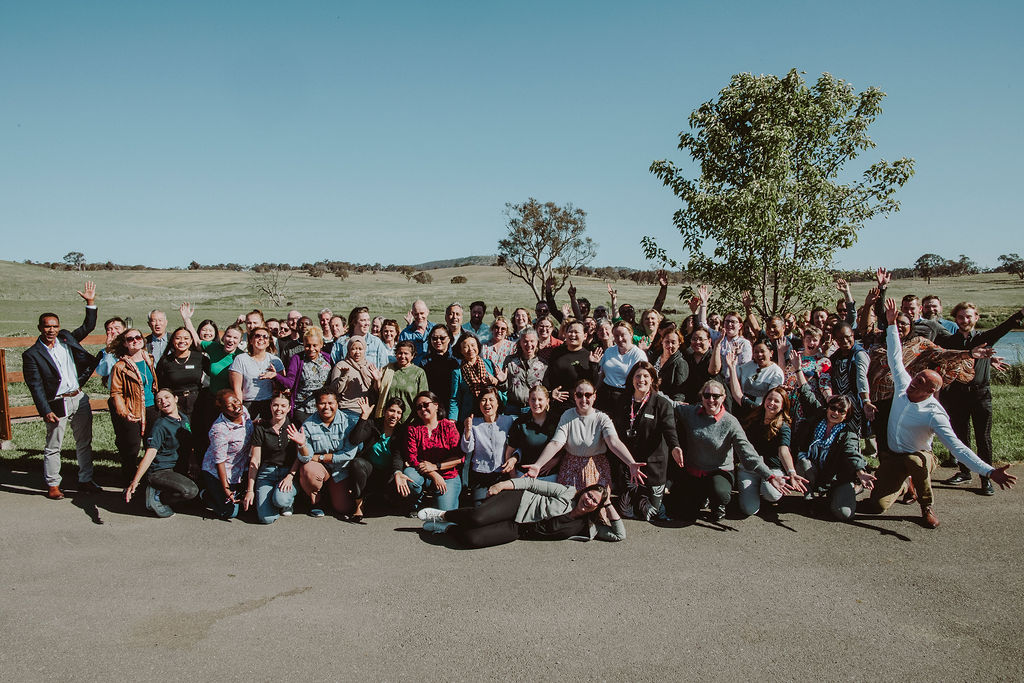
A large group of workshop participants celebrating together outdoors
Five pillars, one life
Why it exists

Most wellbeing thinking starts in the wrong place.

The usual approach

Fix the workplace, fix the person.

Stress at work. Performance at work. Engagement at work. A model that only looks at the job is working with half the picture.

The Five Pillars

Start with the whole human.

What happens at home shapes how someone shows up in the morning. Their relationships, purpose and energy all come to work with them. None of it stops at the door.

Crisis rarely appears out of nowhere. It sits downstream from prolonged disconnection: from self, from others, from a meaningful way of living.
Why most programs fall shortGood intentions, incomplete model

Most wellbeing programs produce limited results. Not because the people behind them don’t care, but because the model they’re using only sees the workplace. The quality of someone’s closest relationships decides their emotional bandwidth. Their sense of purpose, or the absence of it, affects every decision they make. Their physical energy either fuels or drains everything else they attempt.

Seen, not assessedHonest, accessible and actionable

The Five Pillars of Fulfilment starts with the whole human, not just the employee, and gives people a structured, practical way to see where their life is under pressure and what to do about it. It was never designed as a clinical or diagnostic tool. It was designed to be honest, accessible and actionable, so people feel seen rather than assessed.

Built for this momentChange has outpaced us

Change has moved faster than people have adapted to it. AI is reshaping work. Remote and hybrid work have dissolved the line between professional and personal life. Digital communication has made us more reachable and, oddly, more alone. The Five Pillars were built for exactly this moment.

See how we deliver it in practice ›
The Five Pillars

Five dimensions of a whole life.

Each pillar is a part of life that shows up at work whether anyone talks about it or not. Pick one to see what it covers, and how it pulls on the other four.

The lines show how the pillar you pick connects to the other four.

Pillar 01 of 5

Health & Fitness

The foundation everything else is built on.

Physical vitality is not vanity, it is infrastructure. The quality of someone’s sleep, their movement habits, their relationship with food and alcohol, their physical energy levels: these are not lifestyle choices that sit outside the conversation about performance. They are the conversation.

What this looks like in practice

  • Movement habits and exercise consistency
  • Sleep quality and recovery
  • Nutrition and energy management
  • Relationship with alcohol and substances
  • Physical presence and body–mind connection
Go deeper on Health & Fitness

When this pillar is under strain, everything else suffers. Concentration drops. Emotional regulation becomes harder. Relationships feel more difficult. Work feels heavier. Restoring physical vitality doesn’t just improve health metrics, it creates the conditions for every other pillar to function.

In our work with organisations, Health & Fitness is often the pillar people find easiest to engage with first. It’s concrete. It’s measurable. And the wins here, even small ones, create momentum that carries into the others.

Pillar 02 of 5

Internal Work

The pillar most people skip, and the one with the biggest upstream influence.

Internal Work is the hardest pillar to talk about and the most important one to address. It covers self-awareness, emotional intelligence, values clarity, identity, and the internal narratives people carry about who they are and what they’re capable of.

What this looks like in practice

  • Values identification and alignment
  • Emotional awareness and regulation
  • Recognising limiting beliefs
  • Purpose and identity work
  • Mindset and self-talk patterns
Go deeper on Internal Work

Most people arrive at adulthood with a set of beliefs about themselves that were formed in childhood and never examined. Those beliefs shape how they respond to pressure, how they relate to others, whether they ask for help, and whether they feel they deserve a fulfilling life. In the workplace they show up as patterns: the manager who can’t delegate, the high performer who can’t switch off, the leader who avoids difficult conversations.

This is not therapy. It is structured self-inquiry, the kind that gives people language for what they’re experiencing and tools to shift what isn’t serving them.

Pillar 03 of 5

Love & Relationships

The quality of our closest connections shapes everything.

The quality of a person’s intimate relationships is one of the strongest predictors of their overall wellbeing, mental health and even physical longevity. And yet it is almost never addressed in workplace wellbeing programs, as if the most important relationship in someone’s life stops mattering from nine to five.

What this looks like in practice

  • Communication and conflict resolution
  • Emotional intimacy and vulnerability
  • Attachment awareness
  • Relationship values and expectations
  • Support systems within partnerships
Go deeper on Love & Relationships

It doesn’t. A marriage in crisis affects concentration, emotional stability and capacity for patience. A relationship built on genuine support and security creates a stability that makes everything else more possible. This pillar is not about prying into personal lives. It is about acknowledging that the whole person shows up to work, and that supporting the whole person means taking this seriously.

For single people, this pillar addresses relationship readiness, attachment patterns, and the quality of connection being sought and experienced.

Pillar 04 of 5

Social Connection

Loneliness is one of the strongest predictors of declining health and performance. It’s also one of the least discussed.

Beyond our intimate relationships sits a broader layer of connection: friendships, community, belonging and the social fabric of everyday life. This is the pillar that has eroded most dramatically in the modern world. People have more digital contacts and fewer genuine friendships than at any point in recent history.

What this looks like in practice

  • Depth and quality of friendships
  • Sense of belonging and community
  • Ability to ask for help
  • Social confidence and connection rituals
  • Workplace belonging and psychological safety
Go deeper on Social Connection

In men specifically, this pillar is in crisis. Research consistently shows that men’s social networks shrink dramatically after their mid-twenties, and that the absence of meaningful male friendship is a significant driver of the mental health challenges that eventually surface as crisis.

In organisations, this pillar shows up in how psychologically safe people feel, how connected they feel to their colleagues, and whether they experience their workplace as a genuine community or simply a transaction.

Pillar 05 of 5

Work & Life Flow

Not balance. Integration.

Work–life balance implies a scale, as if work and life were two opposing forces to be managed against each other. That framing is both inaccurate and demoralising. The question is not how to do less of one and more of the other. It is how to design a life where professional contribution and personal fulfilment reinforce each other rather than compete.

What this looks like in practice

  • Purpose and meaning in work
  • Work–life integration rather than conflict
  • Boundary-setting and recovery
  • Career alignment with personal values
  • Fulfilment and engagement outside work
Go deeper on Work & Life Flow

This pillar covers purpose in work, the experience of meaning and flow, boundary-setting, career alignment with values, and the quality of life outside work: whether there are enough things beyond the job that matter, replenish and sustain.

For many people this is the pillar they arrive at last, because it needs the other four to be stable enough to examine clearly. But it is also the pillar that connects most directly to what organisations call engagement, discretionary effort and retention.

How they connect

Five pillars. One system.

Each pillar shapes the others, often in ways that stay invisible until you know what to look for. Here’s what it sounds like at work, and what’s really going on.

What’s really going on
  1. Work & Life Flow
  2. Health & Fitness
  3. Internal Work

When Work & Life Flow is under pressure, Health & Fitness is usually the first thing sacrificed. Less movement leads to lower energy, which makes the workload feel heavier, which leads to longer hours, and the cycle compounds. This is not a discipline problem. It is a systems problem.

What’s really going on
  1. Love & Relationships
  2. Internal Work
  3. Work & Life Flow

A difficult conversation at home the night before doesn’t stay at home. Emotional residue from conflict consumes cognitive bandwidth, reduces patience with colleagues and makes even routine decisions feel harder. Supporting Love & Relationships isn’t a personal indulgence. It directly affects professional output.

What’s really going on
  1. Social Connection
  2. Internal Work
  3. Work & Life Flow

Someone who has gradually lost their social connections outside work, friends drifted, social life contracted, may appear functional but is running on empty. Work becomes both their only source of social contact and the place they feel most disconnected. Engagement scores drop. The cause is invisible.

Strengthen one pillar, and you strengthen the others. Neglect one, and the rest start to crack.
The Fulfilment Score

Where are you right now?

Every engagement with us begins here: an honest pulse check across all Five Pillars. Not a personality quiz, not a clinical diagnostic. A clear picture of where you are.

  • 20questions
  • 5pillars
  • 4minutes or so
  • 1clear starting point
Free · about four minutes · no sign-upFind your shape
  1. Answer twenty questions

    Honest, quick, and across all five pillars of your life.

  2. See your picture

    Where you’re strong, and the pillar with the most room to grow.

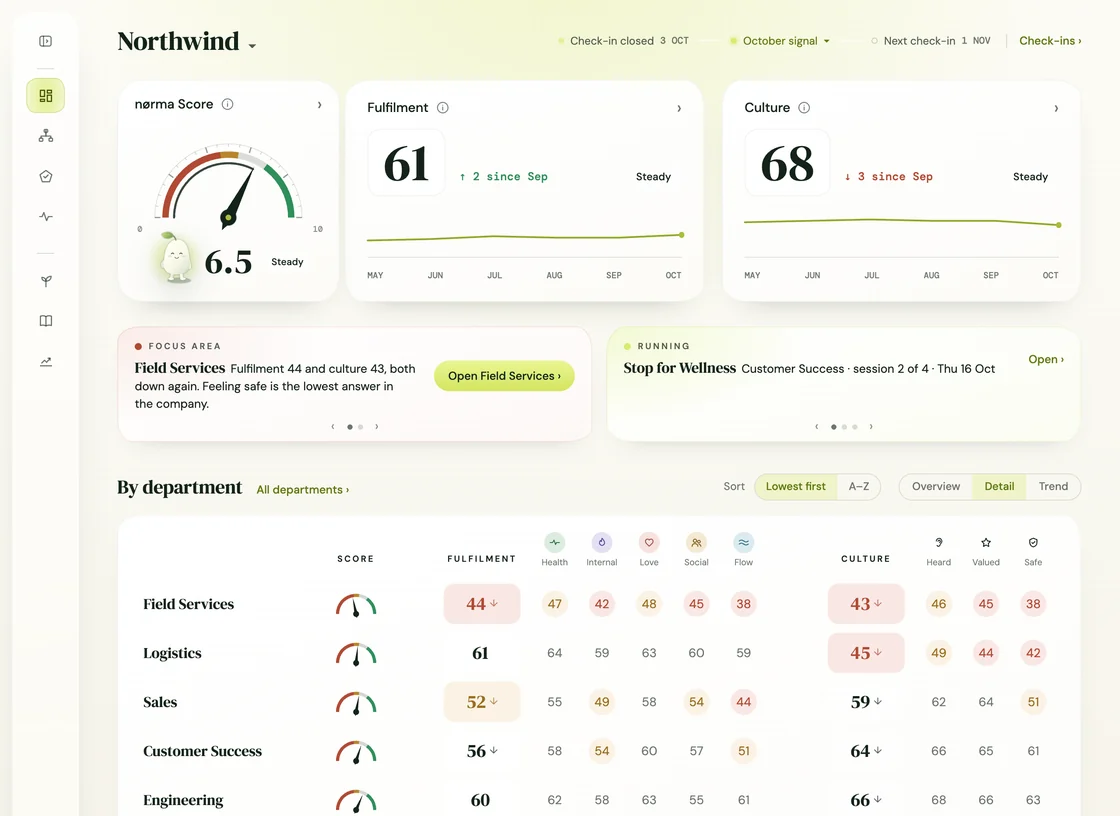
  3. Take it to everyone with nørma

    Wellbeing at scale: every person tracks their score privately, and leaders see it in aggregate across every team.

Why leadership teams take it togetherA shared language, and a baseline

The score creates a shared language. When a leadership team completes it together, they get a common reference point for conversations that are often too uncomfortable to start without one. It also creates a baseline, so progress becomes visible and change becomes measurable.

Bring it to your organisation

Ready to put the framework to work?

Start with a Masterclass for your leadership team, or get in touch and we’ll work out the right place to begin.